
Strategic Benchmarking In Healthcare Real Estate: Unlocking Measurable Cost Savings Through Market Insights

Benchmarking is a well-established discipline in healthcare, used to track and improve performance in patient care, operations, compliance, and financial management.
Key performance indicators (KPIs) such as average length of stay, bed occupancy, emergency department throughput, and nurse-to-patient ratios help gauge operational efficiency. Compliance is monitored through metrics like CMS Star Ratings, Joint Commission audits, and HIPAA incident rates. Financial performance is tracked via indicators such as operating margin, cost per discharge, days cash on hand, and denial rates—enabling leaders to make informed, data-driven decisions.
Recent Examples Of Benchmarking In Action:
- St. Luke’s Regional Medical Center (Boise, ID) reported a 14.8% heart failure readmission rate.
- In 2025, The Joint Commission launched its SAFER® Peer Benchmarking tool for comparative survey analytics.
- Intermountain Health achieved a 6.5% operating margin in Q1 2025.
Bringing The Same Discipline To Healthcare Real Estate
Real estate is one of the largest cost centers in any health system—yet it’s often under-optimized. Benchmarking real estate performance, much like clinical and operational areas, can uncover meaningful opportunities for savings, efficiency, and regulatory compliance.
Are You Fully Leveraging Your Real Estate Portfolio?
Efforts to reduce real estate costs often focus on consolidating space, but true value lies in optimizing what’s already owned or leased. Clinic efficiency assessments help identify underutilized sites or opportunities to expand services without increasing footprint.
Key KPIs in real estate include:
- Margin per Square Foot (Margin/SF)
- wRVUs per Provider FTE
- Margin per Rent Dollar (Margin/Rent)
These metrics reveal underperformance, guide strategic improvements, and support stronger lease negotiations. Understanding downstream margin contribution by site also provides a clearer picture of real estate’s impact on the overall system.
Benchmarking For Compliance And Risk Mitigation
Benchmarking isn’t just about performance—it’s also essential for compliance. Proper documentation and comparisons ensure alignment with regulations like Stark Law and Anti-Kickback Statutes, while protecting against costly penalties.
Best practices include:
- Fair Market Value (FMV) validation
- Audit-ready documentation
- Safe harbor assessments
How Benchmarking Drives Cost Control
Applying benchmarking to real estate decisions helps health systems identify target rent-to-margin ratios, negotiate leases more effectively, and optimize space utilization. By tracking current and historical lease data across markets, organizations can validate rental rates and uncover hidden savings.
Colliers’ Approach: Delivering Tangible Results
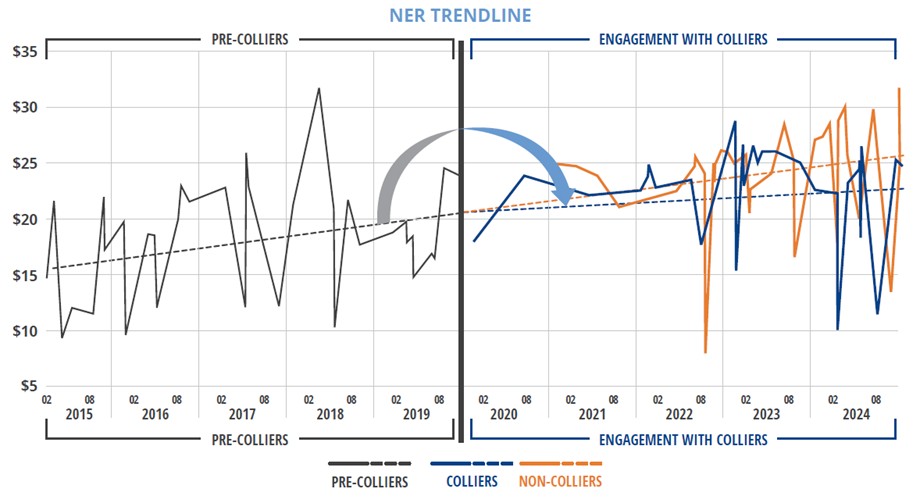
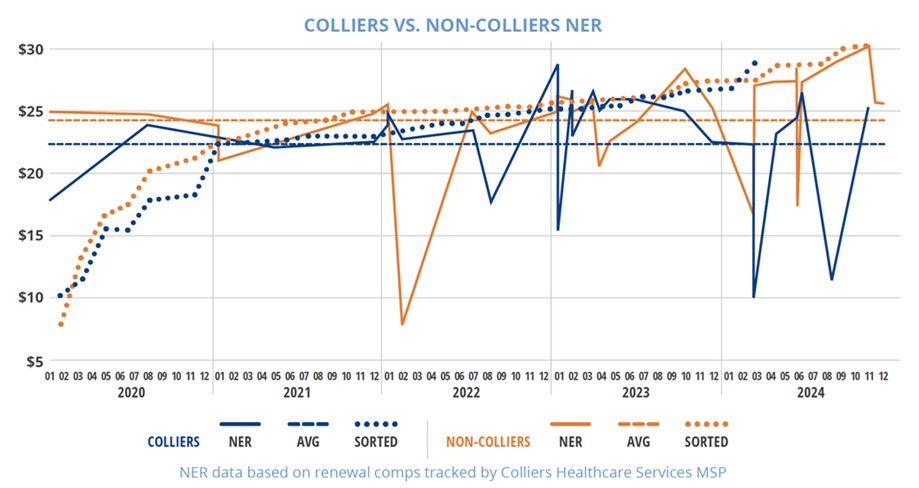
Colliers apply the same rigor to real estate benchmarking that hospitals use for clinical KPIs. Every lease is measured against a comprehensive database of market comparables and converted into standardized, actionable insights.
As a result, clients consistently achieve measurable outcomes—including an average savings of 7.8% compared to prevailing Net Effective Rent (NER) rates.
Source: Colliers
Source: Colliers
Source: Becker’s Hospital Review
For more information contact us:
954.346.8200 x 201