
Aging Population Fuels Greater Demand For Specialty Healthcare Real Estate

The growing number of older Americans is fueling strong expansion in the healthcare sector, which is significantly increasing demand for specialized healthcare real estate.
Source: U.S. Bureau of Labor Statistics, Oxford Economics, CBRE Research, Q1 2026.
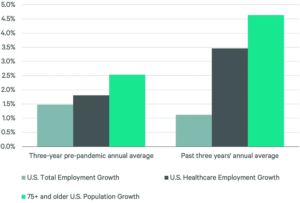
Over the past three years, healthcare job growth has surged well beyond that of the broader economy.
Since March 2023, employment in the U.S. healthcare industry has grown at three times the pace of overall job growth. This acceleration is largely due to a rapid increase in the population aged 75 and older, which has grown at an annual rate of 4.6% in recent years—nearly double the 2.5% annual growth seen in the three years leading up to the pandemic.
In response, healthcare real estate is evolving to meet rising demand. Key influences include pressure on insurance reimbursements, the need for greater patient convenience, and advancements in medical technology. Together, these factors are driving a shift toward a more decentralized healthcare system, with a notable expansion in outpatient care facilities.
Source: CBRE Research, Q1 2026
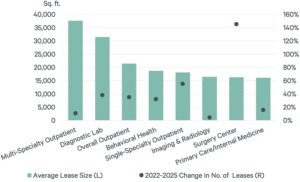
Analysis of hundreds of lease agreements reveals that certain healthcare segments are contributing disproportionately to this demand. Outpatient surgery centers, in particular, have experienced the most dramatic growth, with lease volume increasing by 145% between 2022 and 2025. Their popularity stems from their efficiency, lower costs, and access to advanced technologies.
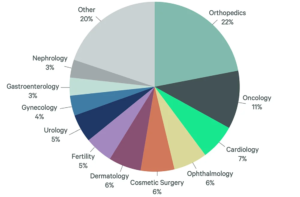
Single-specialty providers have also expanded significantly, with leases increasing by 55% during the same period. This growth is driven by strong demand for services such as orthopedics, oncology, and fertility treatments.
Source: CBRE Research, Q1 2026
Other segments have also seen steady gains: diagnostic laboratories increased lease activity by 38%, behavioral health providers by 32%, primary care and internal medicine by 16%, and multi-specialty outpatient providers by 11%. Imaging and radiology providers experienced more modest growth of 4%.
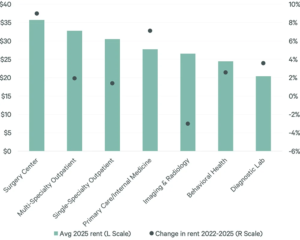
Due in part to their specialized infrastructure requirements, outpatient surgery centers have recorded the largest rent increases over the past three years. In contrast, behavioral health providers and other specialty practitioners—who can often operate in standard office spaces—have seen more moderate rent growth. Rental rates also vary depending on usage, with higher-acuity providers such as surgery centers and multi-specialty groups typically paying higher rents under triple-net lease structures.
Source: CBRE Research, Q1 2026
Looking ahead, demand for outpatient healthcare real estate is expected to remain strong in the near term. However, as healthcare needs continue to evolve, so too will real estate strategies. While purpose-built medical facilities will remain essential, flexible leased spaces will play a critical role in enabling providers to quickly adapt to changing technologies, policies, and patient demands.
Source: CBRE News
For more information contact us:
954.346.8200 x 201