
TEXRail Extension Could Make Fort Worth’s Medical District A New Transit Anchor
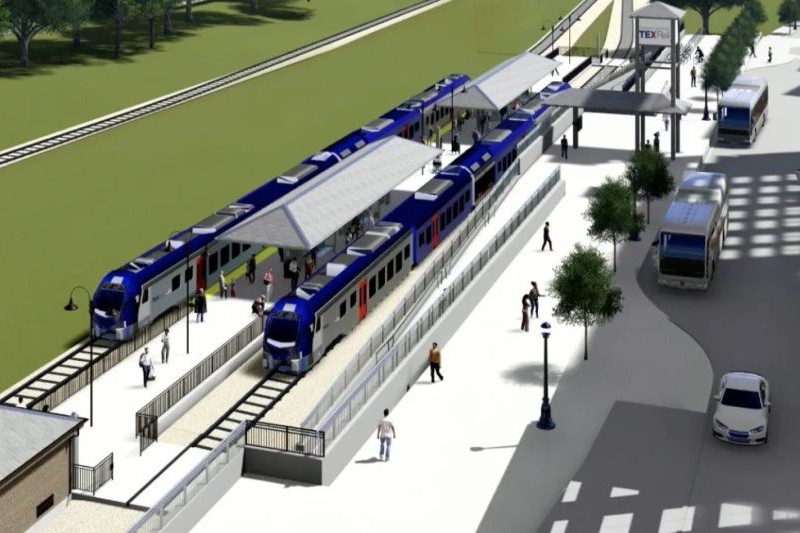
Fort Worth’s Medical District is moving closer to a direct passenger rail connection, with Trinity Metro expecting to break ground on a TEXRail extension in late 2026.
The planned 2.1-mile addition would extend service from downtown Fort Worth into the Near Southside, creating a new station near Baylor Scott & White All Saints Medical Center. The station is planned for Mistletoe Drive, east of Jerome Street, on land donated by Baylor Scott & White Health.
The project, valued at more than $167 million, is now fully funded, according to Trinity Metro President and CEO Rich Andreski, who briefed Fort Worth City Council members this week. Passenger service is expected to begin in 2029.
The extension is viewed as more than a transportation project. Trinity Metro officials said the Medical District station would improve access to one of the city’s major employment centers, where roughly 50,000 jobs are located, while also making regional healthcare destinations easier to reach.
For Trinity Metro, the project reflects a broader shift in how the agency sees its role in Fort Worth’s growth. Andreski said the agency is working to become a more modern and comprehensive transit provider, with a focus on reliability, safety, customer experience and economic development.
TEXRail currently runs between Fort Worth’s T&P Station and Dallas Fort Worth International Airport. Since launching about seven years ago, the commuter rail line has expanded Trinity Metro’s reach beyond its traditional Fort Worth-centered service area and into northeast Tarrant County.
Ridership continues to climb. TEXRail reported a 20% year-over-year increase in February and a 15% increase in March. Through the current fiscal year, the line has carried more than 502,000 riders, compared with about 435,000 during the same period last year.
Agency leaders said the ridership growth shows TEXRail is being used for more than airport trips. Riders are using the service for commuting, shopping, weekend outings and other daily travel needs. Strong weekend ridership has been especially notable.
The rail extension also ties into Trinity Metro’s growing interest in transit-oriented development. The agency recently hired Mike Brennan, former president of Near Southside Inc., as vice president of economic development. His role is expected to focus in part on how station areas can support new housing, commercial activity and mixed-use development.
Trinity Metro officials pointed to Grapevine as an example of rail’s potential economic impact. According to the agency’s analysis, property values and sales tax revenue near the Grapevine station grew at roughly twice the citywide average for businesses within walking distance of the stop.
That kind of station-area growth is increasingly important as Fort Worth continues to expand. The newly renamed Switchyard Innovation District near Texas A&M-Fort Worth and the University of Texas at Arlington’s downtown Fort Worth presence already has about $1 billion in development planned. Trinity Metro officials said rail access could help support that momentum and encourage more investment near transit.
Future expansion possibilities are also being discussed. Andreski said extending TEXRail farther south toward the Chisholm Trail Parkway could eventually improve access to higher education campuses, including Texas Christian University and Tarleton State University’s Fort Worth campus.
Trinity Metro is also studying opportunities for transit-oriented development around TEXRail and downtown stations. Similar efforts are being explored by the North Central Texas Council of Governments and the city of Fort Worth. The Medical District, the Stockyards and the Switchyard Innovation District are among the areas seen as having strong potential for future transit-connected development.
Rail is only one piece of the agency’s broader strategy. Trinity Metro has also been reshaping its bus network. While five low-performing routes were recently discontinued, Route 4 was extended from Stop Six to the Cultural District. The agency is also working with regional transportation officials on Lancaster Avenue mobility improvements and is considering express bus service between southeast Fort Worth and the Alliance area to improve access to jobs.
Council member Michael Crain, who also serves on Trinity Metro’s board, praised the agency’s direction, saying its plans aim to serve both transit-dependent residents and people who may choose transit if the service is convenient enough.
Source: Kera News
For more information contact us:
954.346.8200 x 201