
Posts

GFH Financial Group Acquires U.S. Medical Offices Portfolio In $400M Deal

GFH Financial Group, an investment bank based in Bahrain, has acquired a portfolio of medical clinics in the US in a deal valued at $400 million, expanding its real estate portfolio in the world’s largest economy.

The income-yielding medical clinics portfolio consists of 11 assets with more than one million square feet of space and is spread across California, Texas, Maryland and Louisiana, GFH said.

“We are pleased to announce the acquisition of this prime, income-yielding medical clinic portfolio as part of GFH’s ongoing expansion in the medical office building sector in fast-growing cities across the US,” Nael Mustafa, co-chief investment officer of real estate at GFH, said. “We believe strongly in the long-term fundamentals in the healthcare sector and the dynamics that are supporting an increase in demand for high-quality medical office space.”

To date, GFH has built a portfolio of assets in the US medical office building sector valued at $1 billion. In December, it acquired a portfolio of medical offices in the US in a deal valued at $200M. The medical offices portfolio consists of 11 assets with more than 400,000 square feet of space spread across North Carolina, South Carolina, Georgia, Utah, Wisconsin, Ohio and Texas.

The latest portfolio is anchored by investment-grade credit tenancy through Baylor Scott & White (Moody’s Aa3), Texas A&M Health Science Centre (Fitch: AAA), Texas Tech University (Fitch AA+), Memorial Hermann (S&P A+) and Tidal Health (Moody’s Aa3), GFH said. The assets also offer unique specialisations within their respective submarkets, positioning them for high occupancy and rent growth, it added.

The medical clinics sector has been strong performing and proven to be highly resilient to economic downturns — with 99 per cent rent collection during the Covid-19 pandemic. The sector also benefits from population growth and the aging US population accompanied by an increase in healthcare expenditure, which accounted for nearly 19 per cent of the US GDP last year, GFH said.

“Aging populations and growth in outpatient care … continue to make the sector highly recession-resilient and unimpacted by economic cycles. We look forward to working with our partner Big Sky Medical to maximize the value of these assets,” Mr Mustafa said.

GFH’s partnership with Big Sky has resulted in a number of acquisitions totalling nearly $500M in the past six months. This transaction is the third in a series of joint acquisitions.

GFH Financial Group reported a 10 per cent increase in its second-quarter profit as investment banking income and income from co-investments rose as the company continues to boost its portfolio around the globe.

Net profit attributable to shareholders of the bank for the three months to the end of June climbed to $23.06M compared with $20.92M during the same period last year.


Source: The National News

Medical Office Real Estate Demand Is Outpacing Supply In Dallas-Fort Worth

Medical office space vacancy rates in Dallas-Fort Worth are more than a percentage point below the five-year average as demand remains strong in the region, according to a report from Transwestern.

The report says that the DFW market is undersupplied, but as rents rise, new construction may become more feasible in the future. Interest rates and material costs are rising, which has slowed down all new construction, and the medical office building space is no different. While rent is growing, it hasn’t kept up with other costs, so underwriting for new construction has been more difficult. But if the limited medical office space remains with increasing population in the region, rent prices will rise until new construction can be justified, the report says.

Prior to the pandemic, Dallas was the country’s second-most active medical office building construction market, behind only New York.

“There’s a definite need for increased health care services, more hospital campuses, and more doctors’ offices, but also the real estate that can house them,” says Andrew Matheny, research manager for Transwestern. “When you set that against the construction levels that have been declining over the last couple of years, that’s going to be a significant driver of rents and new development here in the next few years.”

While square footage under construction and 12-month deliveries are down compared to a year ago in the medical office space, those figures could soon be trending in the opposite direction. Vacancy rates in DFW are at 10.2 percent and were 11.6 percent one year ago. Gross rents are also up nearly 3 percent compared to a year ago.

The healthcare market overall continues to grow. Employment for the hospital space is up 4 percent compared to a year ago and 10 percent for other ambulatory service markets. Total available space is at 13.8 percent, which is below the five-year average for the region.

“In the last three to six months, we’re starting to see transactions come through that are bringing revenue in line with these higher costs,” Matheny says. “That may need to happen here for another couple of quarters before we start seeing more groundbreaking projects.”

South Dallas, in-town Dallas, and along the Dallas North Tollway have some of the lowest vacancy rates in Dallas, though there are zero projects under construction in-town and South Dallas, with just 21,000 square feet under construction near the tollway. In the Frisco/Legacy region, there are more than 150,00 sf under construction, but it has one of the highest vacancy rates in the region, at 13. 9 percent. The East Dallas suburbs (17.3 percent) and Grapevine/Southlake (23.1 percent) have higher vacancy rates than Plano/Legacy.

If the market responds as Transwestern is predicting, the new hybrid work environment will probably play a factor.

“If people are spending more time at home, they’re probably going to prefer to see physicians and providers that are close to where they live, so we may see a geographic rebalancing of health care services close to where people live,” Matheny says.

This trend is already making waves with the growing presence of urgent care centers, retail clinics, and free-standing emergency rooms popping up closer to where people live. Hospitals, too, are moving more services away from central hubs and into ambulatory care facilities. It isn’t just more convenient; caring for people outside the hospital is also cheaper.

Telehealth has surged during and after the pandemic, but Matheny doesn’t see it significantly impacting the medical office market.

“While it may allow a physician to reach more people without coming in, physicians still need physical spaces where they can see their patients face to face,” Matheny says. “From a leasing perspective, it’s been a very busy medical office space. There is a demand for it, and I think people want to see their doctor in person.”


Source: D CEO Magazine

South Florida Is Changing, And So Is Healthcare Construction

As people flock to South Florida, demand is rising for new construction in housing, transportation and healthcare.

But in the face of supply chain challenges, escalating prices and a tight labor market, experts in the field believe the success of new projects hinges more than ever on timely decisions and collaboration.

“There’s been a 180-degree shift over the past few years,” says Operations Manager Johnathan Peavy at Robins & Morton’s Miami office. “In the early days of the pandemic, supplies, material and even labor were readily available. We anticipated some supply chain issues due to the pandemic, but no one anticipated the ‘Texas Freeze,‘ which compounded the supply chain woes. Along with secondary shutdowns to heavy manufacturing markets, these have created a title wave of supply chain issues.”

Staggered factory shutdowns have left lingering backlogs of construction supplies, from electrical components to building materials. The problems are compounded by the ongoing supply chain issues and a very tight construction labor market, with cost escalations increasing budget volatility.

At Robins & Morton, supporting clients in a changing market is a top priority – and that process starts on day one with a commitment to transparency and collaboration.

“We want to be available to help every step of the way; not only in building, but in budgeting, scheduling, procurement and approval,” says Peavy. “Making smart choices about which materials to use and when to order them. Or helping the client plan for volatility in the market – for example, carrying over a percentage of the budget each month to be ready for inflation or price hikes.”

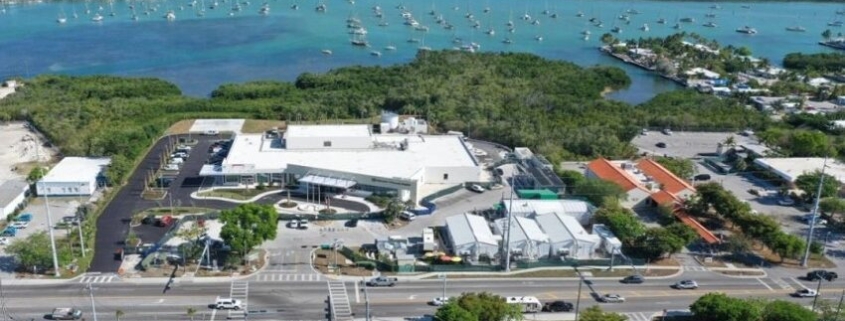
The firm’s collaborative approach serves as an essential strategy when the company faces uniquely challenging projects – such as rebuilding Baptist Health Fishermen’s Community Hospital in Marathon. That same strong communication is key to overcoming market challenges at Robins & Morton’s projects across South Florida, including Jupiter Medical Center’s Surgical Institute Expansion, BHSF Boca Raton Regional Hospital and University of Miami Health System.

“There’s no one-size-fits-all solution,” adds Senior Project Manager Edwige Clark. “It’s about looking at the data you have and trying to spot risks and potential pitfalls before they happen – but the more you can communicate, the more effective all parties can be. We’re navigating this together.”

Those close partnerships help futureproof healthcare facilities. Often, that starts with designs that can significantly reduce the environmental footprint and utility costs. For tropical and coastal environments like South Florida, structures need to withstand humid environments, heavy winds, and potential flooding, and hospitals must remain operational to serve patients during hurricanes or other natural disasters.

“At the end of the day, we’re doing more than meeting parameters. We’re building for people: for healthcare workers, for expecting parents, for folks recovering from illness or injury,” says Clark. “When the construction is finished; it’s in the choices we made that will impact those people for a long time.”

As flexibility in work and transportation allows people to move “where they want to live” and not only “where they need to live,” South Florida is a key destination. An influx of new residents will fuel growth and new developments, which will include healthcare facilities to serve the growing population.

“If so, South Florida will be ready,” says Peavy. “Over the next three to five years, it’s likely the region will continue to grow – and with it, the cycle of new construction. But we’re rising to meet that demand with strong partnerships, new talent and strategies that will help our clients adapt in the years ahead.”


Source: South Florida Hospital News