
Posts

Welltower Sells Senior Living Portfolio for $1.8B; Signs $1B Development Deal

Healthcare REIT Welltower has signed a $1 billion development agreement with Discovery Senior Living, as well as acquired a handful of facilities from the company along with a 6-building, 270,000 square foot medical office campus for $140 million from Summit Medical Group.

The exclusive development agreement focuses on two new projects that the companies are currently reviewing. That, however, is just one piece of a number of agreements struck by the two companies, which have a pre-existing relationship.

“We are excited by the opportunity to expand a key operator relationship,” said Welltower’s Chief Investment Officer Shankh Mitra, in prepared remarks.

Among its agreements, Welltower has:

– Sold its stake in the Benchmark Senior Living portfolio for $1.8 billion. Benchmark has recapitalized the portfolio with private institutional capital. The 4,137-unit seniors housing portfolio consists of 48 assisted living properties located in Connecticut, Maine, Massachusetts, New Hampshire, Rhode Island and Vermont, and had $24 million of secured debt that was extinguished at closing.

– Made an off-market acquisition of three infill seniors housing campuses that are located in the Dallas-Fort Worth and San Antonio metro areas. The portfolio, recently developed by South Bay was acquired for $216 million, or $280,000 per unit, through a newly formed joint venture between Discovery and Welltower. Once the last phase of the Alliance Town Center development in Dallas-Fort Worth opens in the fourth quarter of 2019, the total cost of the portfolio will be $237 million, or $273,000 per unit. In-place occupancy throughout the recently built portfolio (excluding the last phase of the Alliance Town Center) was 72% upon acquisition.

– Gone under contract to fund three newly opened assets located within Discovery’s core footprint in Florida for $92.7 million, or $255,000 per unit. These three buildings achieved certificates of occupancy in the second quarter of 2019. “All of these assets, including those that are under contract, are steel and concrete construction and represent a significant discount to Discovery transactions we have seen in the marketplace recently,” Mitra says.

– Entered into a definitive purchase agreement to purchase a 43-acre, 6-building, 270,000 square foot medical office campus in Berkeley Heights, NJ for $140 million. The campus will be master leased by Summit Medical Group, an independent multispecialty medical practice, under a new 20-year, absolute net lease. This campus is the largest and most comprehensive of five “hubs” in Summit’s 80-location hub-and-spoke model, and will bring Welltower’s total Summit-leased footprint to over 500,000 square feet. The sale is expected to close in the third quarter of 2019, subject to customary closing conditions. The sale of the medical office campus is conditioned upon Summit’s recently announced intended merger with CityMD.

– Acquired a six-community portfolio located in the Denver and Boulder metro areas from Colorado-based Balfour Senior Living for $308 million. The portfolio includes Balfour’s downtown Denver flagship community, Riverfront Park, and the recently developed Lavender Farms, which opened in April. As part of the portfolio purchase, Welltower has received exclusivity on Balfour’s future acquisition and development pipeline, as well as an option to acquire up to a 34.9% interest in Balfour’s management company. Several development initiatives are currently underway in East Coast markets, rapidly expanding the existing relationship between Welltower and Balfour.


Source: GlobeSt.

Healthcare Real Estate Offers Superior Returns

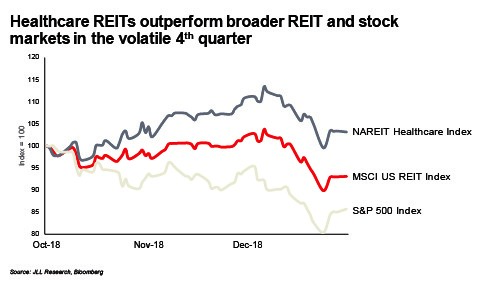
Healthcare REITs outperformed the broad REIT Index and S&P 500 in the fourth quarter 2018, a period of great volatility when equity markets fell 20% at one point.

The NAREIT Healthcare Index closed the year up 3% from the start of the quarter with the S&P 500 ending down 14% and the broad REIT index off 7%.  Healthcare’s positive share movement is linked closely to the movement in U.S. Treasury yields; with 10-year rates declining from 3.05% to 2.68% during the quarter, investor appetite for returns from healthcare REITs grows.

The performance of the healthcare sector’s real estate offerings is a clear reflection that the growing demand for healthcare and long-term care is largely independent of the economy.  Healthcare real estate features long-term leases with predictable income from service providers fulfilling critical medical needs that continue even in an otherwise unpredictable market.

REITs such as Welltower have taken advantage of their buying power during this period, announcing sizeable acquisitions including the $1.25 billion CNL medical office portfolio with 55 buildings totaling 3.3 million square feet as well as more than $500 million of strategic medical office investments.

Healthcare REITs are using more ingenuity to stay in the game for acquisitions through strategic joint ventures.  HCP formed a $605 million joint venture with Morgan Stanley in August 2018 for a 2 million square foot medical office portfolio which included the acquisition of 16 buildings totaling 856,000 s.f. leased to Greenville Health, acquired from Healthcare Trust of AmericaHealthcare REITs vie for strategic health system relationships to develop critical scale and future investment and development opportunities with market-leading providers.

While private equity dominated healthcare competitively through much of 2018 as REIT share values lost ground with the rise in U.S. Treasury yields, the fourth quarter is a reminder of how quickly the table can re-set.  The disciplined strategies of certain healthcare REITs and the surplus of capital chasing healthcare properties today is testimony to the durability of this relatively stable property class.  With economic and market uncertainty, the reliable cash flows of healthcare properties supported by the steady forces of a growing and aging population, make this sector a strong defensive play in today’s market.


Source: Wolf Media USA

Healthcare REITs Signal An Increased Focus On Medical Office

It is earnings season, which means real estate companies are diligently releasing their earnings and analysts are intently scrutinizing said reports. Mizuho REITs analyst Richard Anderson covers healthcare REITs and he noticed a trend among the big 3 companies HCP, Welltower and Ventas in their recent releases: they all are emphasizing strategies involving medical office buildings.

To be sure, MOB is a staple among their holdings but as Anderson tells GlobeSt.com, “it just seemed interesting that each of the three highlighted a very specific strategy aimed at approaching the medical office business to some degree, versus past earnings reports.”

He says that:

  • HCP made mention of its joint venture with Morgan Stanley that’s aimed at investing in medical office as well as a new partnership with HCA to focus on the asset class.
  • Welltower is expected to close about $500 million of MOB transactions in the short term. “Also, they have always talked about using their senior housing portfolio as a quasi hanging carrot for medical office, as a medical office feeder.” The REIT has also brought on board a former Duke Realty executive Keith Knokoli, who has strong credentials in the MOB segment. “You don’t make an investment at that level of executive if you’re not serious about the business.”
  • Ventas is re-igniting its exclusivity arrangement with PMB Real Estate Services. It is a medical office developer that Ventas inherited when it merged with Nationwide Health Properties many years ago, Anderson explains. Ventas just re-upped its exclusivity arrangement with the company for the next ten years, he says.

A Lower Risk Profile

What is strange, he says is that “cap rates on medical office assets that are trading hands are still quite low, but nonetheless REITs are maintaining a fair amount of attention toward the space.” Anderson also points out that medical office assets are known for their stability and relatively lackluster growth while skilled nursing is a higher returning asset class that comes with higher risk.

His tentative takeaway: there is possibly a return to risk-off mentality around the corner for healthcare REITs. “Maybe REITs are becoming buyers of medical offices simply because of their low risk orientation, even though the asset class remains quite expensive.”


Source:  GlobeSt.